
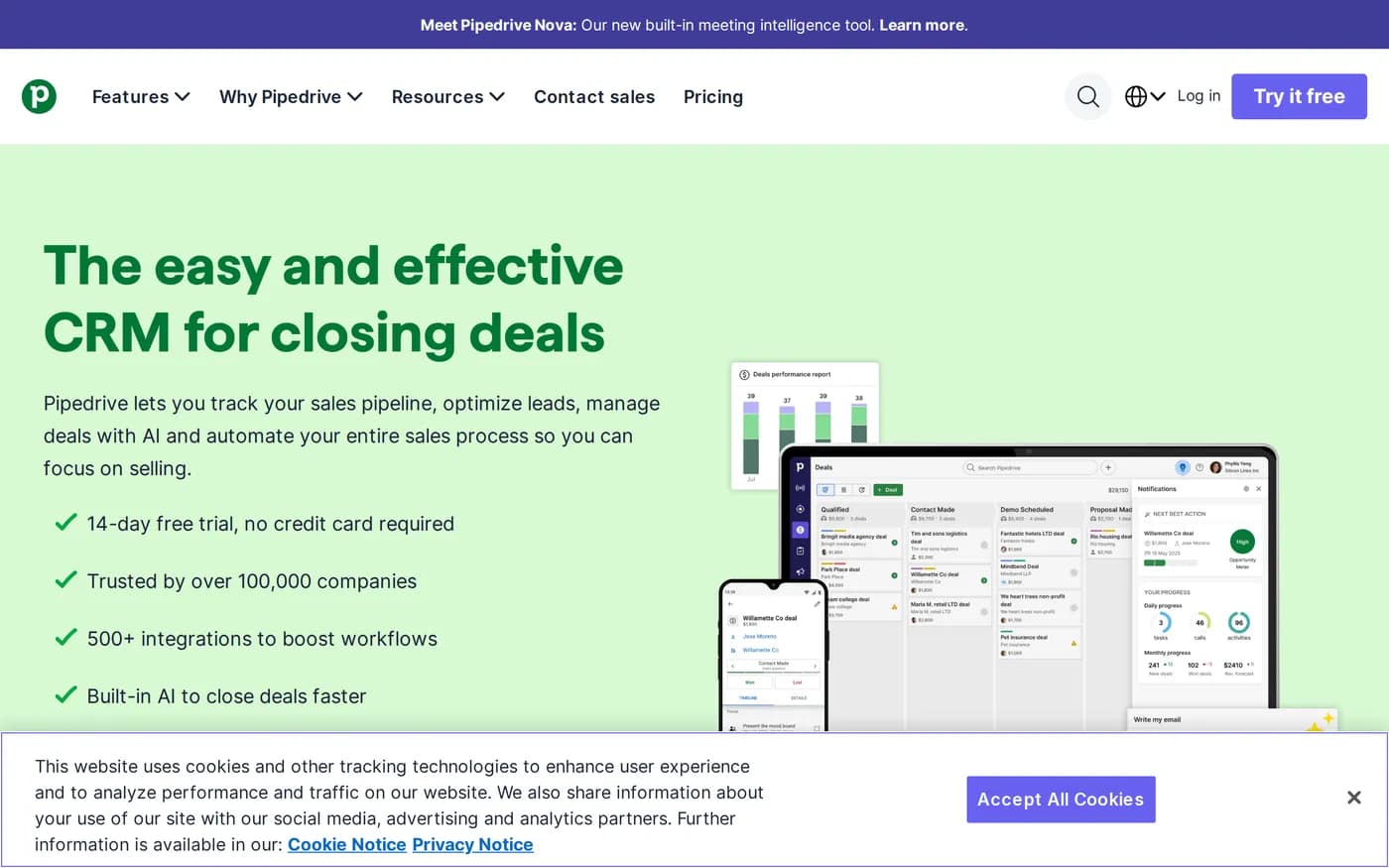
The measure of a CRM is not what it can store. It is whether a salesperson updates it without being chased. By that standard Pipedrive is the best product in this category, and it achieves it by doing something unfashionable: refusing to become a marketing suite.
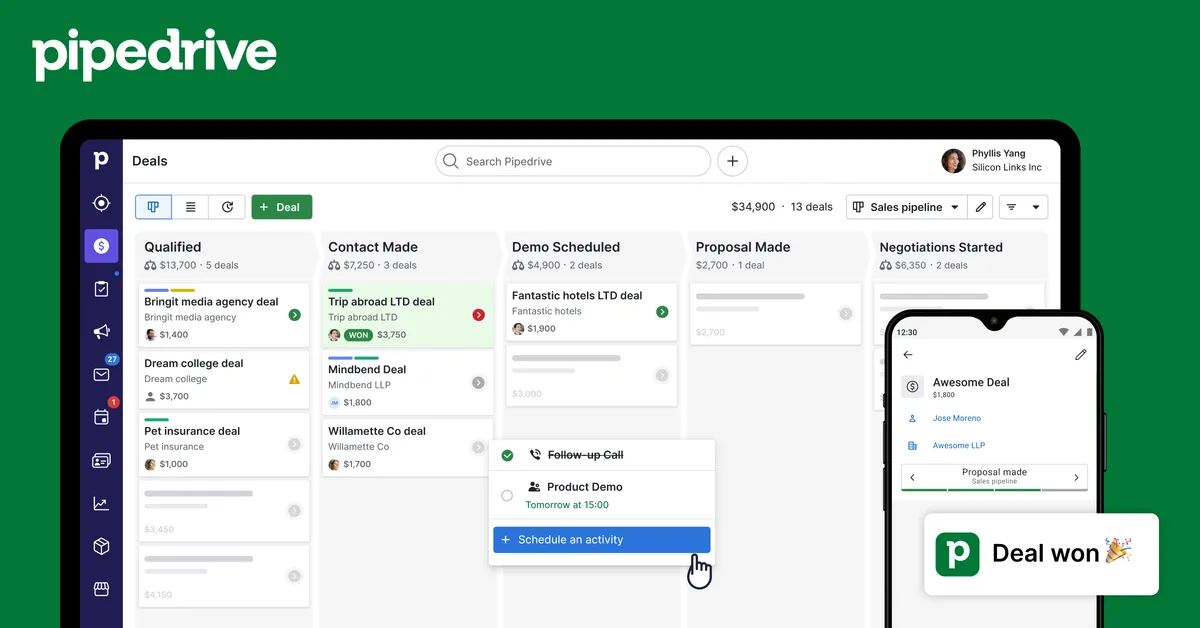
The pipeline is the interface
Open Pipedrive and you get a horizontal board of deal stages with cards in them. That is the home screen. Not a dashboard, not an activity feed, not a set of widgets you have to assemble. The thing you are supposed to work on is the thing you see.
It sounds trivial. It is the whole reason Pipedrive gets updated when HubSpot does not. A rep who has to click through three levels to find today's deals will update the CRM on Friday afternoon from memory, and everything downstream — forecasts, reporting, handovers — inherits that fiction.
Pricing, and the two traps in it
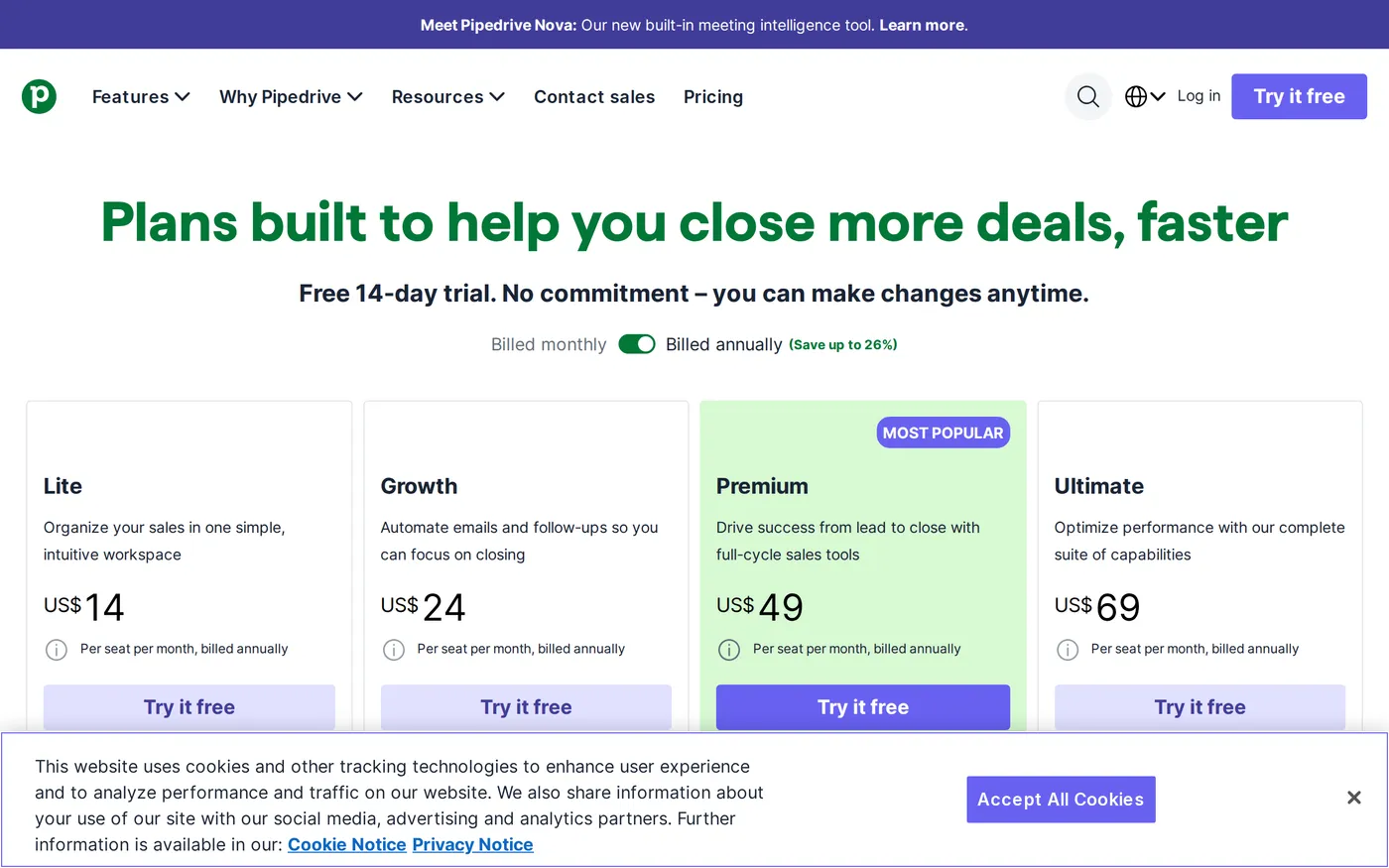
Four tiers, all per seat per month, billed annually:
Lite —
$14. Pipeline, contacts, deals, email sync, basic customisation.Growth —
$39. Workflow automation, email sequences, meaningful reporting, products catalogue.Premium —
$49. Team management, revenue forecasting, project management, more automation volume.Ultimate —
$79. Security controls, permission sets, unlimited reports, the more serious admin tooling.
There is no free plan. There is a 14-day trial with full feature access and no card required, which is more useful than most free tiers because you can test the thing you would actually buy.
Trap one: monthly billing
Month to month the same tiers cost $24, $49, $79 and $99. On Lite that is a 71% premium; on Premium it is 61%. Pipedrive's monthly penalty is among the harshest in this entire review — Asana's is 23%, Slack's around 21%. If you are genuinely uncertain, use the trial, then commit annually. Paying monthly for a year costs more than an annual contract you cancel at renewal.
Trap two: Lite is not the product
Lite has no workflow automation. No automation means no stage-change triggers, no follow-up sequences, no automatic activity creation — which means a human has to remember everything, which is the problem you bought a CRM to solve.
Treat Growth at $39 as the real entry price. Lite makes sense for a two-person consultancy that wants a shared contact database and nothing else. For anyone running a repeatable sales process, buying Lite is buying a spreadsheet with a nicer skin.
Where it is strong
Speed. A Pipedrive board with several thousand open deals still drags smoothly. This is not true of every competitor and it is the kind of thing that never appears in a feature comparison but decides whether people use the tool.
Automation legibility. Pipedrive's workflow builder is a linear trigger-condition-action list. A sales manager can build and audit one without help. Compare this with HubSpot's workflow canvas, where a branching automation built by a departed employee becomes an archaeology project.
Email. Two-way sync, templates, open and click tracking, and sequences from Growth upward. It is not a marketing automation platform and does not pretend to be, but for one-to-one selling it covers the ground.
Where it runs out
Reporting is the ceiling. Pipedrive's reports answer pipeline questions well — conversion by stage, deal velocity, activity volume, forecast by close date. Ask a cross-object question, like revenue by industry segment against marketing source over eight quarters, and you are exporting to a spreadsheet or pointing a BI tool at the API.
In practice that ceiling arrives somewhere around thirty reps, or earlier if you have a RevOps function with opinions. That is not a criticism of the product so much as a description of where its market ends.
The second limit is breadth. There is no native marketing automation, no service desk, no CMS. Pipedrive sells add-ons and integrates widely, but if your strategy is one vendor for the whole revenue stack, this is not that vendor — and you should read the HubSpot review before concluding that one vendor is what you want.
Migration and exit
Pipedrive exports deals, contacts, organisations, activities and notes to CSV without drama, and its API is well documented. Getting data out is genuinely easy, which is rarer in this category than it should be. What does not travel is the automation logic and the field customisation — but that is true of every CRM, and Pipedrive's is at least simple enough to rebuild.
Verdict
Pipedrive scores 8.4 because it solves the actual problem — reps not updating the CRM — rather than the problem vendors prefer to sell against, which is feature coverage.
Buy Growth at $39 a seat annually. Move to Premium when you need forecasting or team-level permissions, which is usually around fifteen reps. Ignore Lite unless you genuinely only want a shared address book. Plan details are on Pipedrive's pricing page, and the monthly rates are listed there too — look at them once before you choose a billing period.
Softmarque is not paid by the products it reviews. Prices and plan names were taken from the vendor’s own pricing page on the date shown above and change often; nothing here is financial, legal or accounting advice.