
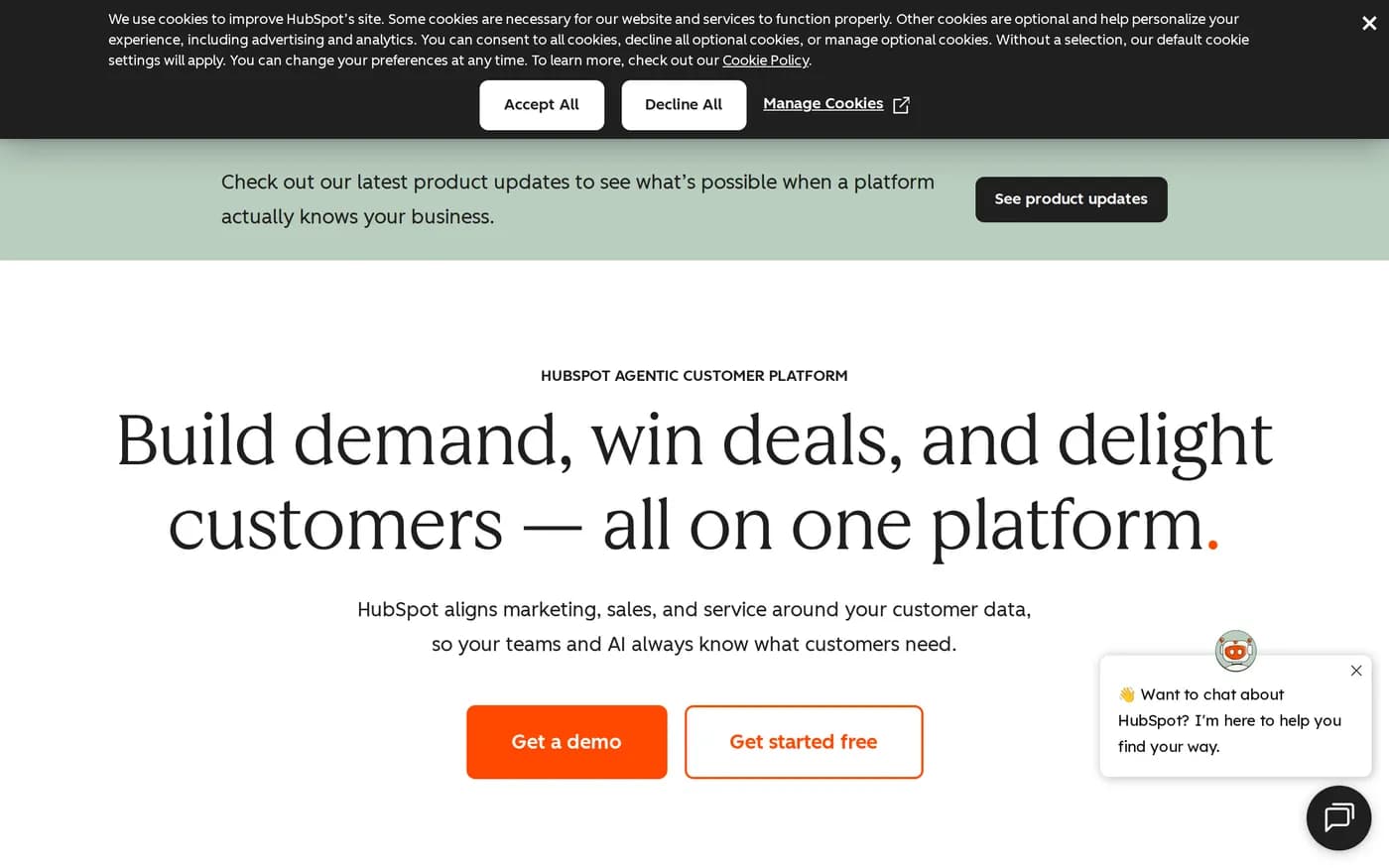
HubSpot is the most successful freemium product in business software, and the mechanism is worth understanding before you adopt it, because the mechanism is the review.

The free tier is not a trick
Start with what is actually good. HubSpot's free CRM gives you contacts, companies, deals, tasks, email tracking, meeting links and a shared inbox, for up to two users, with no time limit and no card. Thousands of companies run their entire sales operation on it.
Nothing else in this category comes close at zero. Zoho's free tier is capped at three users and is visibly a trial. Pipedrive has no free tier at all. If you are pre-revenue and need a CRM this week, this is the answer and the rest of this review can wait a year.
Starter, and what it does not include
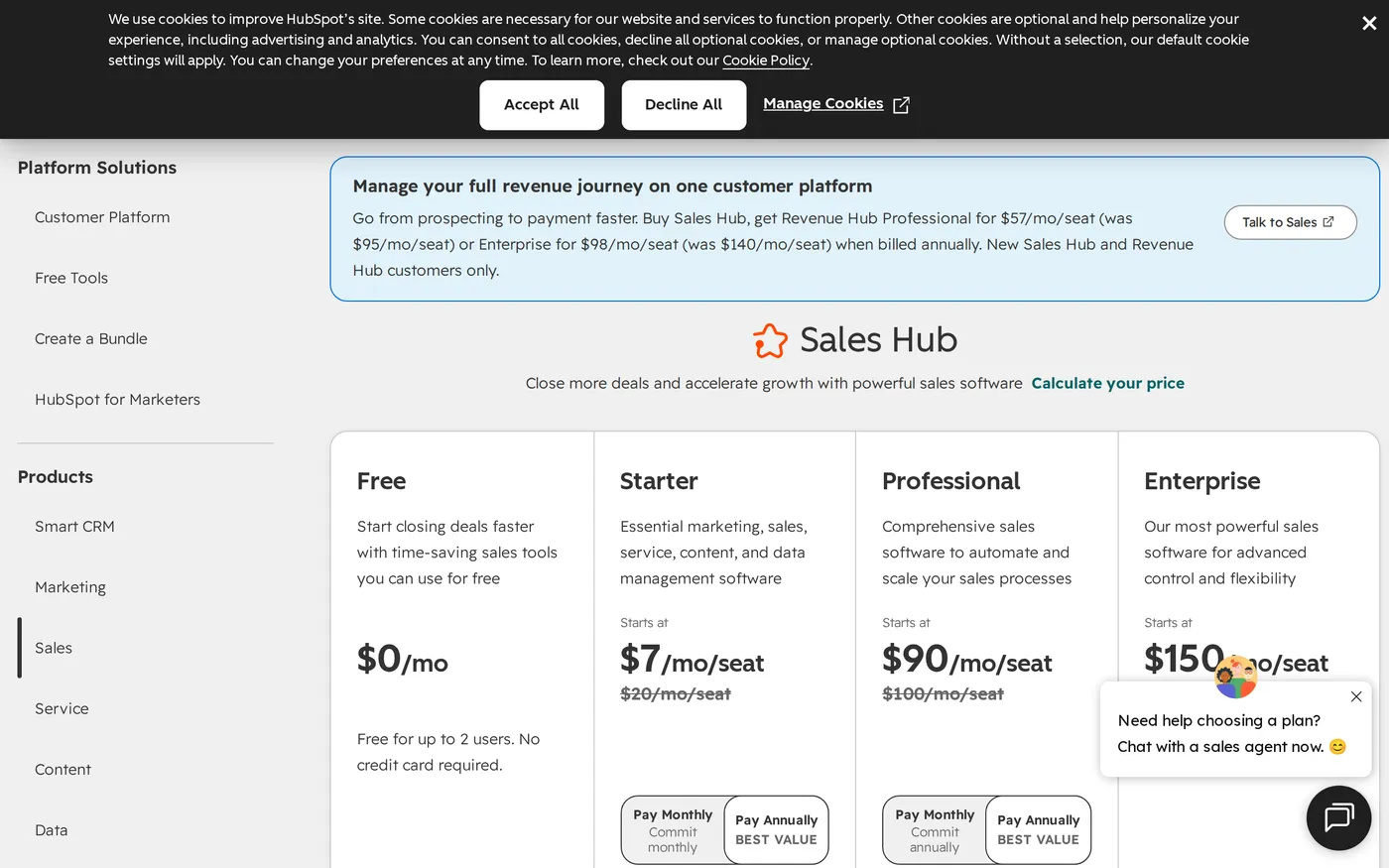
Starter is $7 per seat per month on annual billing, $20 month to month, and bundles 500 HubSpot Credits. It removes the branding, lifts the free limits, adds simple automation, a few pipelines and basic reporting.
At seven dollars this is the cheapest credible paid CRM in this round-up — below Zoho Standard at $14 and half of Pipedrive Lite. For a team of five that is under $500 a year.
What Starter does not have is the part that matters at scale:
Workflow automation — the real branching kind, not simple task creation
Custom reporting beyond a small library of prebuilt reports
Sequences at volume, forecasting, and deal scoring
Teams, territories and the permission granularity a manager eventually wants
The cliff
Professional is $90 per seat per month annually ($100 monthly), with 3,000 credits — and a mandatory one-time onboarding fee of $1,500. Enterprise is $150 per seat with a $3,500 onboarding fee.
Read that as a sequence rather than a table. A five-person team on Starter pays $420 a year. The same five people on Professional pay $5,400 a year plus $1,500 up front: $6,900 in year one. That is a 16× increase, triggered by needing one feature — usually workflows.
The onboarding fee is the detail to hold on to. It is not optional, it is not negotiable at the self-serve level, and it does not appear in any of the comparison tables that rank HubSpot as the affordable option.
Why the jump catches people
A team adopts the free CRM because it is free and good.
Data accumulates. Processes are built around HubSpot's objects and properties.
Someone asks for an automation that routes leads by territory and notifies an owner.
That is a Professional feature. The alternative is migrating a CRM that now holds two years of history.
By step four the switching cost has been quietly engineered to exceed the price difference. That is excellent business design and it is also why HubSpot scores 7.2 here rather than higher: the product is good, the path is not honest about where it leads.
Marketing contacts, if you use more than Sales Hub
One more billing mechanic worth knowing. Sales Hub is priced per seat; Marketing Hub is priced per marketing contact — a count that grows on its own as your list grows, with no relationship to headcount.
If you adopt both — and HubSpot's whole strategy is that you will — your bill has two independent growth curves: headcount and list size. Teams routinely discover that a successful lead-generation quarter raised their software bill without anyone approving it. Audit which contacts are marked as marketing contacts quarterly; it is the single highest-leverage cost control on the platform.
What HubSpot is genuinely best at
The unified record. When sales, marketing and support all write to the same contact, you get a history that no integration between three separate vendors reproduces reliably. If your company sells through content and nurture rather than outbound calling, that integration is worth real money and is the strongest argument for paying the Professional price.
The documentation and training are also the best in this review, by some distance. HubSpot Academy is a genuine asset, and the practical effect is that you can hire someone who already knows the tool.
Verdict
Use the free CRM. It is excellent and it costs nothing. Use Starter if five dollars a head is easier than a procurement conversation.
Before you build anything load-bearing, answer one question honestly: will you need branching workflow automation within eighteen months? If yes, price Professional at $90 a seat plus $1,500 now and compare it with Pipedrive Growth at $39. If Pipedrive covers your process, adopt Pipedrive before the data makes the decision for you. Current figures are on HubSpot's Sales Hub pricing page.
Softmarque is not paid by the products it reviews. Prices and plan names were taken from the vendor’s own pricing page on the date shown above and change often; nothing here is financial, legal or accounting advice.